
Interactive Wall Art: When Every Viewer Sees Something Different
What happens when a painting refuses to reveal itself completely at first glance?
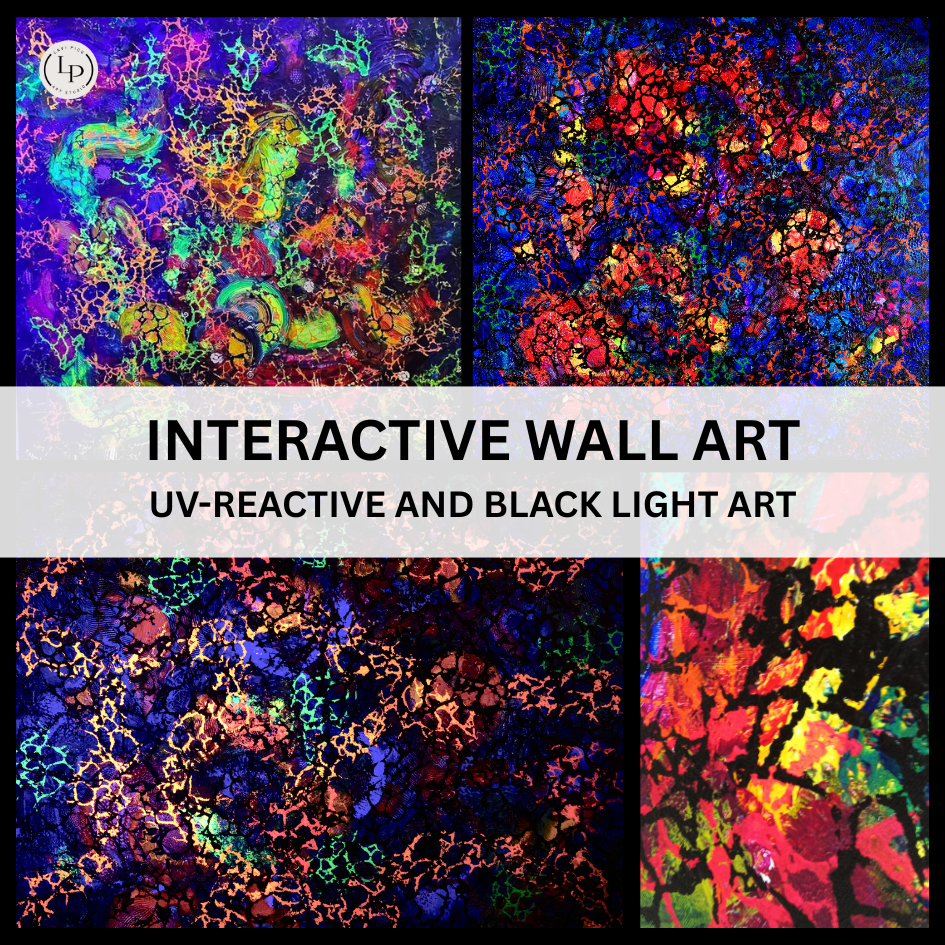
My large-scale paintings are often described by visitors in very different ways. Some call them interactive wall art. Others see UV-reactive art, blacklight art, fluorescent artwork, or even psychedelic wall art. Some have described them as glow in the dark wall art or fluorescent wall art. Others simply see something they cannot quite name.
For me, that uncertainty is part of the work.
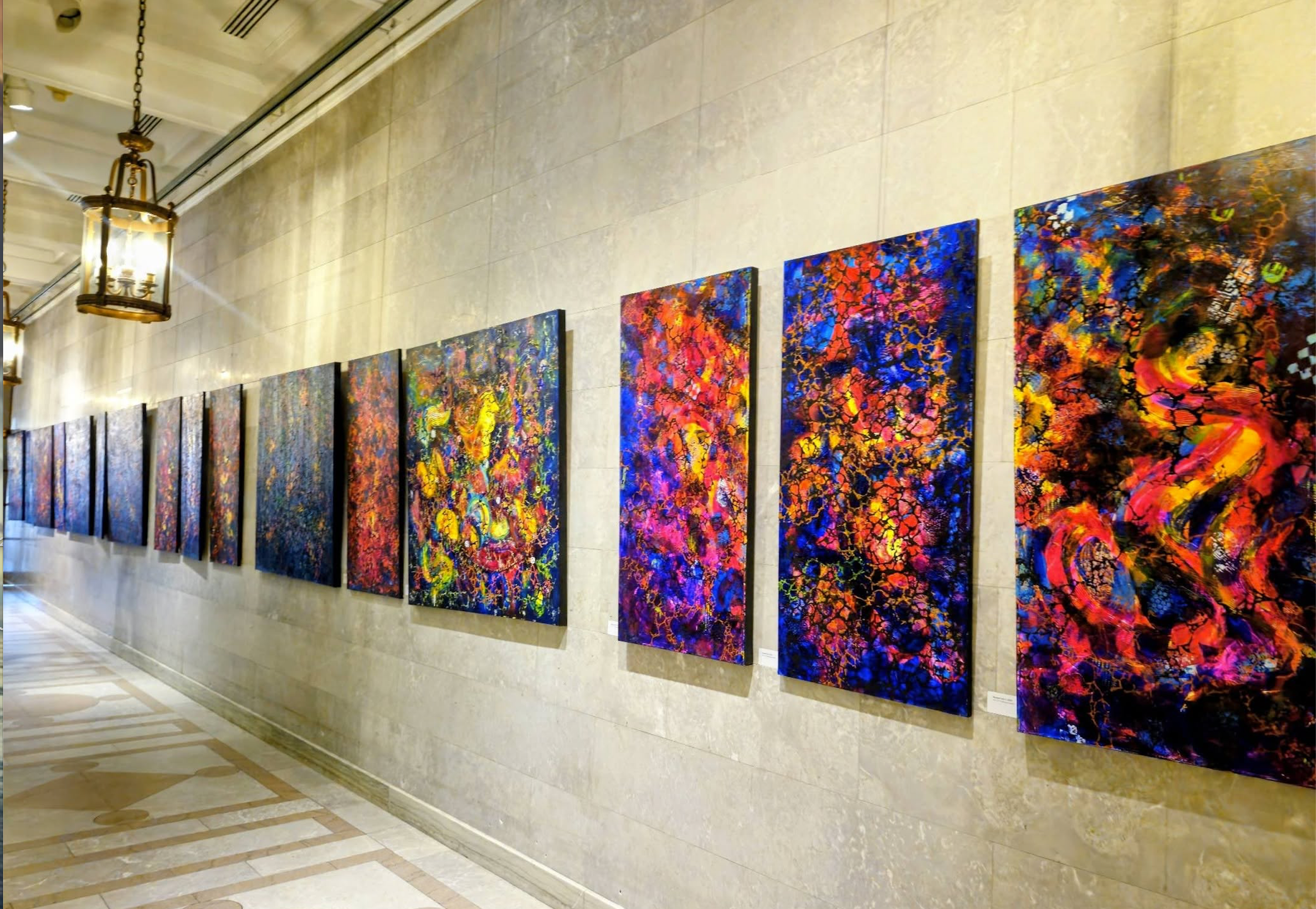
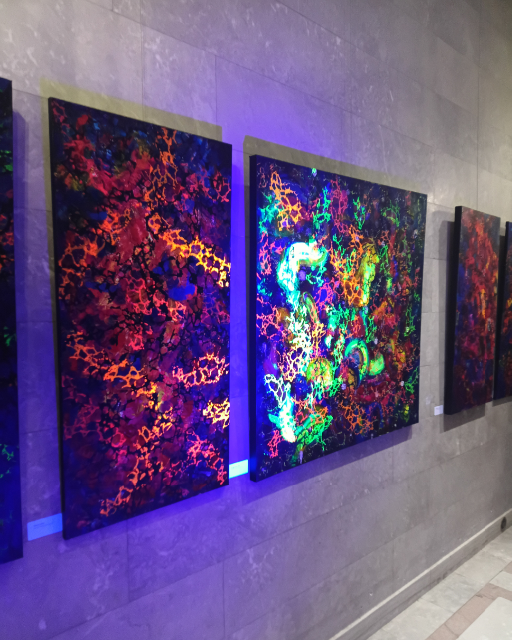
My large-scale series, including paintings measuring 48 × 48 inches and 48 × 24 inches, explores invisibility, perception, the body, and the realities that exist beneath what we normally see. Created with UV-reactive pigments and materials, the paintings change dramatically when exposed to ultraviolet light. What appears one way under ordinary light can become something entirely different under blacklight.
The artwork is not simply something to look at. It asks the viewer to look again.
Beyond the traditional painting
I am interested in what happens when painting moves beyond the traditional, static viewing experience.
A conventional painting may present itself in a relatively stable way: the viewer stands in front of it, observes it, and interprets what they see. My UV-reactive paintings introduce another layer. Light becomes part of the experience, and the viewer becomes an active participant.
During exhibitions, visitors have been invited to explore the works using UV flashlights and, in some installations, 3D glasses. These elements encourage viewers to move, investigate, compare what they see under different conditions, and discover details that are not immediately visible.
This is where the idea of interactive wall art becomes important.
The interaction is not necessarily about physically touching the artwork. It is about changing the conditions of looking. The viewer's position, attention, expectations, and response all become part of the experience.
UV-reactive art and the hidden image
The use of UV-reactive pigments is particularly meaningful to my practice.
Under regular lighting, certain elements remain subdued or almost invisible. Under ultraviolet light, they emerge with intensity. Colours shift. Forms become more pronounced. New relationships appear between shapes and layers.
This transformation is connected to one of the central concerns running through my work: invisibility.
Something can be present without being immediately visible.
This idea extends beyond the physical properties of the materials. It can refer to experiences, emotions, bodies, memories, and realities that remain hidden from ordinary view. The paintings create a visual metaphor for the difference between what is seen and what is actually there.
That is why blacklight art is more than an aesthetic choice in my work. The blacklight becomes a tool for revealing another dimension.
Why visitors see different things
One of the most interesting aspects of these paintings is hearing what people see in them.
A visitor may see a microscopic landscape. Someone else may see a biological structure, an emotional state, a landscape, a creature, a body, or something completely abstract. Another person may describe the work as psychedelic wall art because of its intense colours, fluid forms, and altered visual experience.
There is no single correct answer.
In fact, I am interested in what happens when viewers bring their own experiences and associations into the work.
The paintings contain enough ambiguity to allow different interpretations. Rather than telling viewers exactly what they should see, I create an environment where they can discover their own reading.
The different names visitors give the work are therefore revealing. When someone calls a painting fluorescent artwork and another person calls the same painting psychedelic art, they are not necessarily disagreeing. They are describing their individual encounter with it.
Conceptual art that invites participation
Although the works can initially attract attention through their colour and visual intensity, the ideas behind them are central.
My practice is rooted in conceptual art, where materials, processes, and visual choices are used to explore larger questions.
The UV-reactive paintings ask questions about visibility and perception:
What do we fail to see?
What becomes visible only when we change the way we look?
How much of reality depends on the conditions through which we perceive it?
These questions also connect the paintings to my interest in socially engaged art.
When viewers gather around the works, exchange interpretations, point out details to one another, or discover something they had not noticed before, the artwork becomes a starting point for conversation.
The meaning is not produced by the artist alone.
It is created through an encounter between the artwork and the people experiencing it.
Fluorescent wall art with another dimension
The large scale of these paintings is also intentional.
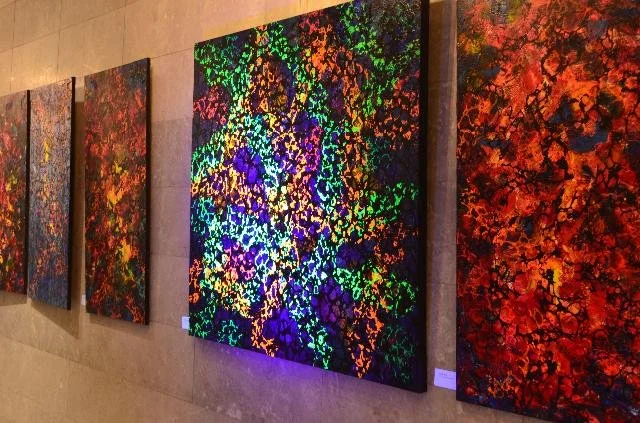
At 48 × 48 inches, the works occupy a significant physical presence. The viewer cannot always take them in from a single glance. At 48 × 24 inches, the vertical or horizontal format creates a different relationship with the body and the surrounding space.
Scale changes perception.
Standing close to a large painting can reveal details that disappear from a distance. Stepping back can transform those same details into a larger image. Adding UV light introduces yet another transformation.
The painting therefore exists in multiple states.
It is not one fixed image.
It is an experience that changes depending on how and when you look at it.
The artwork continues in the viewer
I don't necessarily want viewers to leave an exhibition with the same interpretation I had when I created the work.
I want them to leave with questions.
Perhaps they saw something biological. Perhaps they saw something emotional. Perhaps they thought of a microscopic world, a dream, a body, a landscape, or something entirely personal.
Maybe they simply experienced the pleasure of discovering something hidden.
That is what makes this body of work more than glow in the dark wall art or decorative fluorescent painting. The visual transformation is only the entry point. Beneath the colour and light is an invitation to reconsider how we see—and how much remains unseen.
For me, interactive wall art is ultimately about creating that encounter.
The painting begins on the wall.
But its meaning continues in the person standing in front of it.